
PCBA Potting Material Selection Guide: Epoxy, Polyurethane, and Silicone Compared
SUNTOP Electronics
PCB Assembly Team
Choosing a PCBA potting material is a design and manufacturing decision, not just a line item on a bill of materials. Two projects may both need a board protected from moisture, vibration, dust, or electrical exposure, yet need very different resin systems. A rigid epoxy can be appropriate for one enclosure, a flexible polyurethane can suit another, and silicone can make more sense where thermal movement or later serviceability changes the priorities.
The right PCBA potting material depends on the actual product: the operating environment, enclosure geometry, component mix, heat path, allowable weight, repair plan, cure window, test sequence, and any material or compliance requirements. Material family is a useful starting point, but it is not a substitute for a specific product datasheet and validation plan.
This guide compares epoxy, polyurethane, and silicone potting compounds from an engineering and production perspective. For the dispensing, vacuum, cleaning, and staged-pouring side of the process, see the existing PCBA potting process guide.
Why PCBA Potting Material Selection Affects Reliability, Cost, and Process Planning
Potting fills all or part of a cavity, enclosure, or selected assembly area with a cured compound. Once cured, that compound becomes part of the product. It can protect the assembly, but it can also change mechanical stress, heat transfer, mass, access to components, test points, and the ability to rework a unit.
That means material selection affects more than environmental protection:
- how the resin flows around tall components, connectors, and narrow cavities
- whether a two-part mix, controlled temperature, vacuum degassing, or staged fill is needed
- how strongly the cured compound constrains components during vibration or thermal cycling
- whether heat is retained, transferred, or blocked by the final assembly design
- whether the product can be repaired, inspected, or upgraded after curing
- how the supplier plans masking, fixtures, cleaning, cure time, and final inspection
A material that looks ideal on one datasheet can be a poor fit if it creates stress on a large component, blocks a required connector, prevents a necessary functional test, or makes an approved repair impossible. Start by defining the protection problem before selecting the chemistry.
Useful questions include:
- What is the actual exposure: condensation, splash, dust, chemicals, vibration, thermal cycling, or high voltage?
- Is the goal environmental sealing, mechanical retention, insulation, heat transfer, tamper resistance, or a combination?
- Must the assembly remain repairable after field return or production test?
- Does the enclosure create a deep cavity, trapped-air geometry, or limited resin access?
- Are there approved material, flame, thermal, or compliance requirements from the end product?
Epoxy Potting Compounds: Strengths, Tradeoffs, and Typical Risks
Epoxy potting compounds are often considered when a design needs a hard, durable encapsulation with strong adhesion and robust mechanical support. Many epoxy systems cure to a relatively rigid result, which can be useful when the assembly should be firmly retained inside an enclosure or when resistance to a demanding environment is a primary concern.
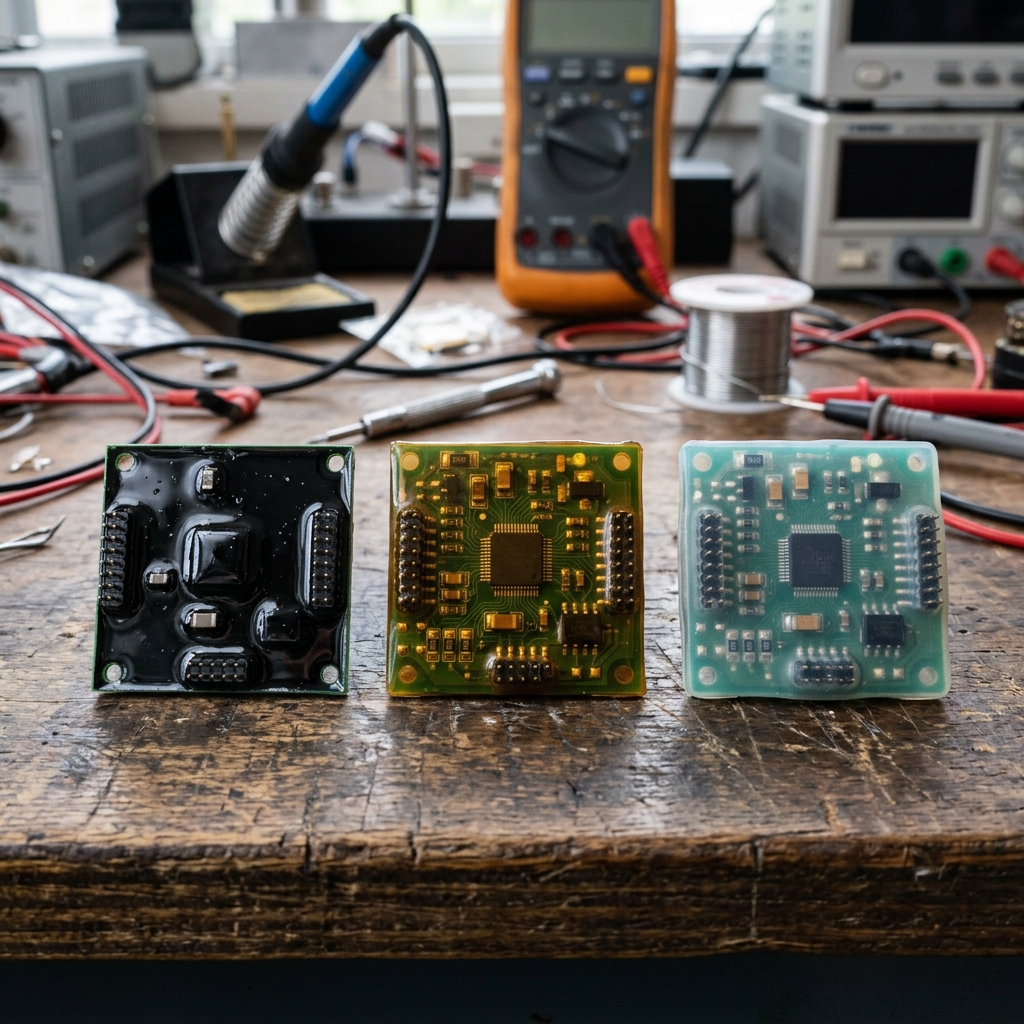
Physical comparison of rigid epoxy (left), elastomeric polyurethane (center), and soft compliant silicone (right) on identical target boards.
The important qualifier is that epoxy is a broad family. Different formulations vary in viscosity, cure schedule, filler content, hardness, thermal behavior, electrical properties, color, and flame-related performance. A thermally conductive filled epoxy, for example, should not be treated as interchangeable with a general-purpose rigid encapsulant.
Potential reasons to consider an epoxy system include:
- the product needs a firm, mechanically supportive encapsulation (typically providing Shore D 70 to 90 hardness after cure)
- the enclosure and component geometry can tolerate a more rigid cured material
- the application requires a specific approved epoxy formulation (with typical thermal conductivity of 0.2 to 0.5 W/m·K, which can reach 1.5+ W/m·K with thermal-conductive fillers)
- protection and long-term physical retention matter more than easy repair
The main tradeoff is stiffness. When a rigid compound is bonded to parts that expand or move differently during temperature changes, the design can create stress at solder joints, leads, package interfaces, wires, or enclosure boundaries. That does not mean epoxy is unsuitable for thermal cycling; it means the full mechanical system needs review.
Rework is another constraint. A rigid cured resin can make access to failed components difficult or impractical. Before specifying epoxy, agree on whether the intended service model is repair, replacement of the whole module, or limited factory-only rework.
For a supplier handoff, provide the exact material or acceptable equivalent, mix ratio and cure requirements when specified, fill boundary, permitted keepouts, and any test or sample-approval requirement. Do not assume that a generic note such as “black epoxy potting” communicates enough for production.
Polyurethane Potting Compounds: Where Flexibility and Environmental Resistance Matter
Polyurethane potting compounds are commonly evaluated when a project needs more flexibility than a typical rigid epoxy system. A properly selected polyurethane can help accommodate movement from vibration, cable strain, board flex, or differences in thermal expansion between components and the enclosure.
This flexibility can be helpful for assemblies that are mechanically active or exposed to changing temperatures, but it introduces its own selection work. Polyurethane systems vary greatly. Their cure behavior, moisture sensitivity during processing, chemical resistance, hardness, adhesion, and long-term environmental suitability depend on the exact formulation rather than the family name alone.
Polyurethane may be worth evaluating when:
- the assembly includes larger components, wires, connectors, or geometry that may move relative to the enclosure (where a cured hardness of Shore A 40 to 90 provides elastomeric relief)
- vibration or repeated thermal change is an important design concern (within typical operational ranges of -40°C to +120°C)
- the product needs a softer encapsulant than a rigid epoxy can provide
- a defined polyurethane system already exists in the product qualification package
Do not treat “flexible” as automatically safer. A softer material may require careful fixture design, controlled fill height, cure handling, and inspection criteria. It can also affect how the product behaves under compression, how it retains heat, or how easily a surface is damaged during service.
The production team also needs to know whether the resin must be conditioned, mixed under particular conditions, protected from moisture, or cured in a controlled window. Those details affect material preparation, dispensing setup, work-in-process time, and quote accuracy.
Silicone Potting Compounds: When Thermal Cycling and Repairability Are Key Concerns
Silicone potting compounds are often evaluated where low mechanical stress, flexibility across temperature change, or a less rigid encapsulation is important. Some silicone systems can remain comparatively compliant after cure, which can help in designs where components, wires, or housings have different expansion behavior.
As with epoxy and polyurethane, silicone is not a single performance category. Formulations differ in viscosity, cure chemistry, adhesion, thermal behavior, electrical properties, filler content, and compatibility with surrounding materials. The actual datasheet, cure mechanism, and assembly materials matter.
Silicone can be a useful candidate when:
- the product is exposed to repeated thermal cycling (maintaining extreme flexibility from -50°C up to +200°C+)
- a low-modulus material is needed around sensitive components or wire terminations (featuring soft Shore A 10 to 60 or gel-like structures)
- the design requires flexibility after cure (with thermal conductivities ranging from 0.2 to 2.0+ W/m·K depending on custom filling)
- the product team needs a defined path for limited service or material removal, subject to the selected compound
The tradeoffs should still be reviewed carefully. Some silicone systems can create adhesion, contamination, or downstream processing considerations. Their cure requirements may also affect handling and throughput. A silicone choice should therefore be coordinated with enclosure materials, labels, coatings, sealants, test fixtures, and any later process that contacts the assembly.
How Potting Material Properties Change Manufacturing Setup and Inspection
The material decision reaches directly into the manufacturing plan. It changes how the supplier prepares the equipment, verifies dispense quality, controls cure, and inspects the finished unit.
Typical Physical Property Ranges by Material Family
| Property | Epoxy Resin | Polyurethane (PU) | Silicone |
|---|---|---|---|
| Typical Hardness | Shore D 70 to 90 (Rigid) | Shore A 40 to 90 (Tough/Flexible) | Shore A 10 to 60 (Soft/Gel) |
| Thermal Conductivity | 0.2 – 0.5 W/m·K (Up to 1.5+ filled) | 0.2 – 0.4 W/m·K | 0.2 – 2.0+ W/m·K (Filled grades) |
| Operating Temp Range | -40°C to +130°C | -40°C to +120°C | -50°C to +200°C+ |
| Adhesion Strength | High (Excellent bond) | Medium to High | Low to Medium (May need primer) |
| Reworkability | Extremely Difficult | Difficult (Chemical/Mechanical) | Moderate (Can be peeled/cut) |
| Material property | Production question it creates |
|---|---|
| Viscosity | Can the resin reach narrow areas without trapping air or leaving voids? |
| Mix ratio and cure chemistry | Is controlled metering, dynamic mixing, or a defined working-time window required? |
| Hardness and flexibility | Does the fixture need to support cables, connectors, or components while curing? |
| Thermal behavior | Does the fill height or enclosure design change heat flow or stress risk? |
| Adhesion | Are cleaning, drying, primer, or surface-preparation steps required? |
| Rework difficulty | Which tests must happen before potting, and what failures can still be repaired afterward? |
For example, a change from one material to another may require equipment cleaning, material-path verification, trial shots, cure confirmation, and a revised inspection approach. A supplier needs those inputs before quoting so that the line is planned around the product rather than forced to react after release.
Use a selection sequence instead of starting with a resin name
An efficient material review starts with the product requirement and narrows the choice in stages. First, list the environmental and functional risks the resin must address. Next, review the mechanical system: enclosure, cables, component height, board support, mounting points, and expected temperature movement. Then decide whether the finished module must be repaired, inspected, or merely replaced if it fails in service.
Only after those questions are answered should the team compare candidate materials against data sheets and internal qualification requirements. A practical review sequence is:
- Define the protection function and the critical zones.
- Define the mechanical and thermal constraints around the assembly.
- Define the access, test, and repair model after cure.
- Confirm which materials are approved or acceptable for the end product.
- Run a representative sample and document the accepted process and appearance.
This sequence prevents a common failure mode: selecting a compound because it worked on an earlier product and then discovering that the new enclosure, component mix, test path, or service model is different. Similar-looking modules can create very different potting requirements.
Treat substitutions as an engineering change
Material availability, color, cure time, or cost may encourage a supplier or customer to consider a substitute. That decision should not be handled as an informal purchasing change. A substitute can alter viscosity, mix behavior, cure profile, adhesion, stress, dielectric performance, and the inspection or test sequence.
When an alternative is acceptable, state the approval path in the RFQ. Identify who evaluates the technical fit, what documents must be compared, whether a new sample is needed, and which production parameters must be revalidated. This keeps material changeover from becoming an untracked reliability risk.
What to Specify Before Asking a PCBA Supplier to Quote Potting
A quote request should identify the material decision and the product constraints around it. The following information improves both engineering review and production planning:
- exact resin part number or acceptable material family and performance requirements
- safety, compliance, flame, thermal, or dielectric requirements that govern selection
- assembly drawing, enclosure drawing, fill area, target fill height, and no-fill zones
- connector, LED, sensor, switch, label, screw-hole, and test-point masking requirements
- operating environment and expected temperature, vibration, moisture, or chemical exposure
- required test sequence before and after potting
- acceptable bubble, void, cosmetic, and fill-level criteria
- cure requirements, sample approval process, and expected repair or replacement strategy
The PCB assembly service and quality testing service should be part of the same discussion. Potting cannot be planned in isolation from assembly, inspection, final test, packaging, and the manufacturing handoff process described in the PCB assembly order process.
Conclusion
The best PCBA potting material is the one that matches the complete product requirement, not the one with the most attractive single property. Epoxy, polyurethane, and silicone each have useful roles, but each also changes stress behavior, process control, cure planning, inspection, cost, and repairability.
Before release, turn the material choice into a clear manufacturing input: identify the approved formulation or acceptable performance range, define the fill and masking requirements, document the environment and test sequence, and agree on whether the unit must be serviceable. Send those details through the contact page so the material and process can be reviewed before production starts.
FAQ About PCBA Potting Material Selection
Is epoxy always better for mechanical protection?
No. Epoxy can provide a firm encapsulation, but its rigidity may be unsuitable for some component, enclosure, or thermal-cycling conditions. Material selection should consider the full assembly, not one property.
Which potting material is easiest to rework?
There is no universal answer. Rework depends on the specific material, fill geometry, adhesion, access to the failed part, and allowed service process. Define the repair strategy before selecting the resin.
Can a supplier choose an equivalent resin?
Only when the customer permits it and the performance requirements are clear. An equivalent material should be reviewed against the application environment, cure process, electrical needs, thermal behavior, and qualification requirements.